Monday, February 13, 2012

      Being born into this present society of mixed races and acceptance of Black people, I have always been used to the modern day sense of equality in America. This is why, before recently, I have neglected to understand the density and seriousness of the efforts Black people had to give to become the recognized citizens they are today, and the crimes of white people resisting so harshly in many states to accept them as equals. Although there were countless numbers of misleading headlines, and extreme exaggerations in media, the American impression of the level of cruelty that the blacks had to face in the early nineteen hundreds was not far from the truth. The Chicago race riots of 1919 had notorious examples of the peak of racial tensions in American history.

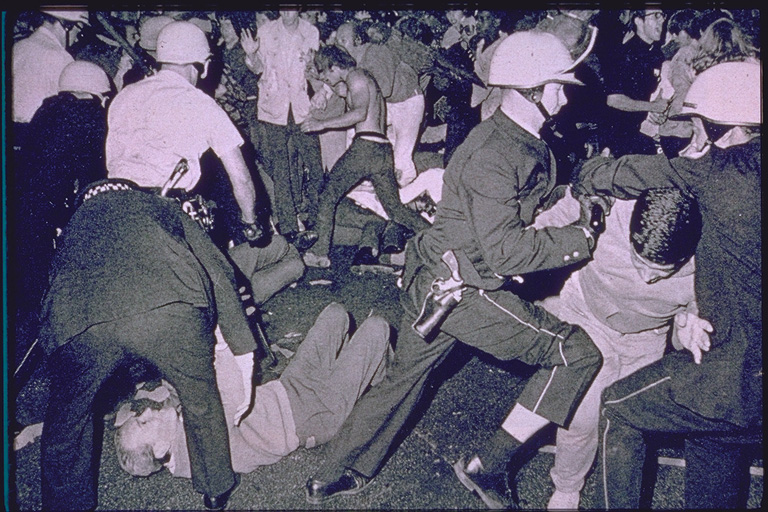
http://www.tahg.org/module_display.php?mod_id=113&review=yes This picture shows the amount of force that was needed to break up these mobs and control the crowds.
     Before the early nineteen hundreds, Chicago had strangely always been known for their fair racial attitudes. However, tension grew after more and more black people began to migrate to the North after World War One. As black people moved to Chicago, in spite of segregation laws, white people refused to conform to black acceptance. Anger and tension in the city grew as whites continued to deny blacks equal rights in employment, housing, and any sort of political representation. I have begun to understand that white people in this time period were raised as superiors to blacks. My grandfather, Jim Caudle Sr. tells me stories of when he used to work in the family meat market at the early age of 7 years old, until halfway through high school. When he stood behind the counter and took orders in from costumers, he says that fully adult grown black men had to call him sir. It's hard for me to imagine life that way, but my grandad says that it was regular old common courtesy that was accepted and expected, and that's just the way it was.

     After living in this way that white people were taught to for so long, they became angry when they were suddenly told that they had to change their traditions, and welcome black people as equals. And they did not accept these new ways without quarrel. As tensions were reaching boiling point in Chicago in 1919, it was the tragic event of the drowning of a little black boy that started the outbreaks of the Chicago race riots. Many versions of this story are told, but the most common tells that a black child was swimming in an area that whites established as off limits to black people. People threw rocks at the child, and caused him to drown. When on looking policeman refused to arrest the white man who was the instigator, chaos broke loose on the beach. 


  Madness soon spread throughout Chicago mainly on the south side of town. For seven days the city was streaming with shooting and beating between white and blacks. "Many African Americans became victims of white mobs when they had to pass through white neighborhoods in order to reach their workplaces.  Others were attacked on streetcars or in city parks and other public venues."  Militia were sent in, but only interfered slowly. They were understaffed, and had sympathy for the whites. 


 1 http://www.blackpast.org/?q=aah/chicago-race-riot-1919- This picture shows the reality of the cruelty and unreasonable punishment on the blacks.


Eventually, the militia gained control and stopped the violence. 15 whites and 23 blacks were killed in the riots. 537 were injured badly. (342 black, 195 white).

      The shock of the riot in Chicago helped shake the nation and understand that segregation was wrong, and that Black people were only trying to make a living. President Wilson took action and declared whites as the instigators in the riots. Laws were passed to help harmonize the races, and bring peace to the city and the country. This period was also marked in history as one of the first times for black men to stand up and fight for their rights.

      Although the level of cruelty and the crimes that were committed are somewhat unspeakable, the riots did give the country a sense of realization. It made many whites stop and think about their rights and wrongs, and eventually to accept black people into the communities. Although it took way longer than it should have, all the fighting and protests eventually paid off for the blacks, in that they are equally accepted today. In my research, I have gained immense respect for black people that stood up for their rights in Chicago, and the rest of the country. Even though Blacks did many things they shouldn't have in these riots, it takes extreme bravery to fight against the system and society. 


http://www.semp.us/_images/biots/Biot521PhotoE.jpg This picture from a newspaper shows the rare occurrence of the militia stepping in to help this black person, escorting him away from a mob. 


Tuesday, January 31, 2012

After researching and looking through some of the diaries letters and other memorobilia, I have engaged interest in WW1. I've never given much thought as I do now to the Great war, but instead considered it an unconcerning event that was so long ago that it has nothing to do with me, and not realizing its vast importance. I am slowly understanding that this war was not so long ago and the men fighting in it were people like me. Other than the clothes and some of the new crazy languages we teenagers speak now, these men were more or less just like me. These thoughts along with the various memorobilia I looked at are showing me the true realism of this war.

 http://www.oucs.ox.ac.uk/ww1lit/gwa/document/9257/5964
http://www.oucs.ox.ac.uk/ww1lit/db/document.php?CISOROOT=/gwa&CISOPTR=8951&CISOSHOW=3638&DMSCALE=75&DMWIDTH=600&DMHEIGHT=600&DMX=0&DMY=0&DMMODE=viewer&DMTEXT=&REC=1&DMTHUMB=1&DMROTATE=0

http://www.oucs.ox.ac.uk/ww1lit/gwa/document/9315/5500
http://www.oucs.ox.ac.uk/ww1lit/gwa/item/2784?CISOBOX=1&REC=1
http://www.oucs.ox.ac.uk/ww1lit/gwa/item/3469?CISOBOX=1&REC=10

Monday, January 23, 2012

Sources

http://www.history.navy.mil/faqs/faq42-1.htm
http://www.greatwhitefleet.info/
http://www.loc.gov/rr/news/topics/greatfleet.html

Friday, January 13, 2012

GWF Research

I learned from the online articles the history of the 16 ships. I learned where they stopped and the different problems they had such as coal shortage.

Tuesday, November 8, 2011

American Crime in the late 19th Century

             In late 19th century America, this great country was still being formed and growing rapidly. Changes and laws were being created all the time in the government’s effort to quickly adjust to the rapid and exciting atmosphere of the states. However, with very little law enforcement compared to today, along with our society, crime was growing too. Some people that wanted to become wealthy, but felt they could not do it through hard work chose to become outlaws; taking their life into their own hands by stealing whatever they could, and killing whoever got in their way. Pat Crowe, Jesse James, and Al Capone were some famous outlaws who ruthlessly defined crime in the late 19th century.
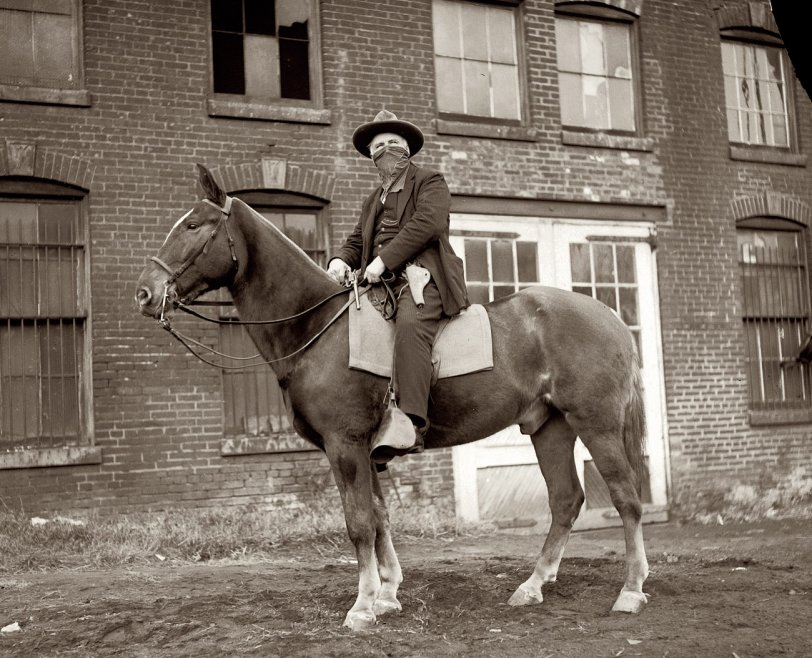
            Through robbing street cars, murder attempts, multiple kidnappings, and train robberies Pat Crowe made a name for himself in the 1920s. He was born in Iowa, and began working at a butcher shop when he was 17. Crowe was caught stealing money so he got fired. His criminal profession did not take off for some time, but around the late 1880s he began telling people that his name was Frank Roberts, and got serious about his law breaking. He began robbing jewelry stores and kidnapping people asking for ransom. He once attempted to kidnap John D. Rockefeller, but was not successful. His most famous kidnapping was of Edward Cudahy, from whom he gained a ransom of 25,000 dollars.
             (The Encyclopedia of American Crime By: Carl Sifakis Vol.1 2nd ed.)
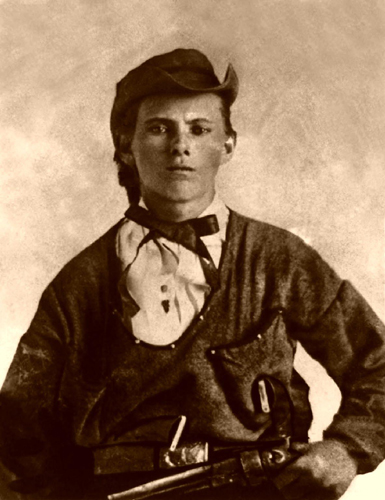
            One of the most notorious outlaws in America was the famous Jesse James. Many people came to admire James writing about how stole from the rich and gave to the poor, and was a 19th century robin hood. These accusations were completely false. Jesse James stole whatever he wanted from anyone he wanted, and kept it for himself. He ruthlessly murdered anyone who was in his way without hesitation. Jesse James’ record stands on multiple and countless train robberies, bank robberies, homicides, and anything else he could organize. Supposedly Jesse and his brother Frank committed the nation’s first bank robbery. Jesse James was a clever and sly outlaw that played by his own rules. He once robbed a bank while they were having a political rally out front, and after he finished, he walked out the front door, and told them that someone was robbing them. When the officials ran inside, Jesse picked up his money and walked out.
(Mobsters and Gangsters) (The Encyclopedia of American Crime By: Carl Sifakis Vol.1 2nd ed.)

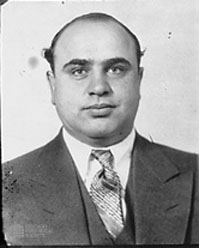
One more infamous criminal was the great Al Capone. As America’s “best known gangster” and “single greatest symbol of the collapse of law and order in the United States during the 1920s Prohibition era,” Al Capone created a name for himself in a different style of crime. Capone in his adult life ran the streets of Chicago with his gangs of thugs. He spread his wings and owned all sorts of organizations that he used to increase his power such as “speakeasies, bookie joints, gambling houses, brothels, horse and race tracks, nightclubs, distilleries and breweries at a reported income of $100,000,000 a year.” Capone earned his money through business and organized crime, instead of bank robberies. He took advantage of the few laws that Chicago had in the 1920s.
(Mobsters and Gangsters)
            These Men define crime in the late 19th century by taking advantage of the lack of law enforcement in America. Some people choose to be outlaws, and try to slip through cracks in the law. Laws are created from experience and observation of crime. Without them most of our laws would not exist, and our world would be full of chaos.  


Je
Pat Crowe 


Wednesday, October 19, 2011

Numba 10

Much  of the violence attributed to the Molly Maguires was instigated by informers and agents working for the mine owner. They wanted a pretext for ruthless measures to suppress unionization!!